
The NSW Terramation Bill
Latest news
As of 15 October 2026, the Public Health Amendment (Terramation) Bill 2026 unanimously passed in the Legislative Assembly and will now move to the Legislative Council to be debated by the end of 2026. This new option is now legally called terramation, alongside cremation and burial.
Start thinking about what kind of tree you’ll be because Australia is on track to become the next country to legalise terramation (formerly called human composting). Uniquely, this new option allows people to become trees and gardens when they pass away. On 15 October 2026 the Public Health Amendment (Terramation) Bill 2026, introduced by Independent Member for Sydney Alex Greenwich, passed the NSW Legislative Assembly unanimously. It is the furthest any terramation legislation has travelled in Australia, and its next stop is the Legislative Council.
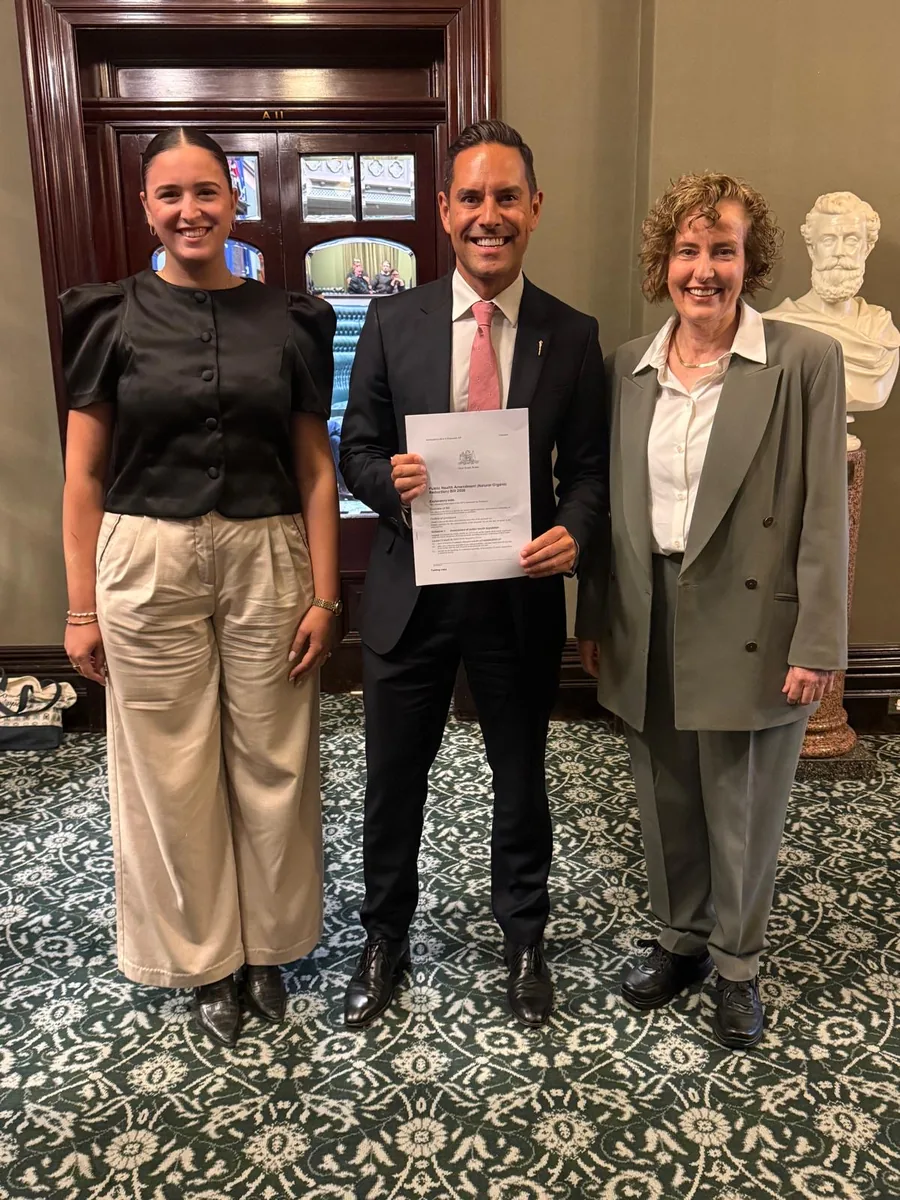
Evergrove has been a key contributor to the Bill and continues to collaborate closely with Alex Greenwich’s team. Our founder, Aria Kapaniris, was in the galleries during the debate on 15 October and met with Alex Greenwich afterwards. Evergrove’s feedback has focused on seeing the Bill pass in a form that is in the best interests of the families and communities it seeks to serve. It’s incredibly difficult to find issues that all the parties can agree on, and we commend Greenwich for the Bill passing unanimously. Terramation is still not legal in Australia. The Bill has to pass the Council and then receive assent, and the terramation provisions do not commence until two years after that date.
What the Bill proposes
Terramation would become a new option alongside burial and cremation for people in NSW to choose. The bill does not mandate this practice for anyone, it simply gives the NSW Government the power to establish the rules, processes, standards, and oversight under which it can be safely and lawfully offered.
Why it matters now
For most of modern history, Australians have had two choices: burial or cremation. Both carry real costs, to the land, to the climate, and increasingly to families’ budgets. There are lots of practical reasons terramation makes sense. But the most important is that our last ever choice carries profound meaning, and terramation honours the end of our stories in a way that feels commensurate with the enormity of life itself. Living memorials give us hope and meaning when we need it most.
What changed in the Assembly
The Government moved 23 amendments. Two of them matter a great deal to us, and both were recommendations Evergrove put forth, informed by extensive and ongoing engagement with community, industry and government since 2023.
- The process is now called terramation in law. Amendments 1 and 23 removed the former name from the Bill’s short and long titles and inserted “terramation”, so its official title is now the Public Health Amendment (Terramation) Bill 2026. The change runs through the whole Bill: “composting” becomes “terramation”, “composted” becomes “terramated”, and “dead bodies” becomes “human remains”. Composting terminology is gradually being phased out due to its undignified waste connotations. Some feel that composting is more to the point because like all living things, humans are made of organic matter and our bodies are biologically built to return to the earth. However, the historical evolution and adoption of the word cremation, instead of incineration, demonstrates why direct language isn’t always the answer. Language is powerful and there are sensitivities that must be observed for how we talk about our deceased loved ones. Most global jurisdictions do not classify human remains as waste, and composting will always have waste connotations. Evergrove encourages the widespread adoption of terramation for all these reasons, but also because we want to help create a world where death is less taboo. We think this looks like our society talking more openly about death so that we can broaden our collective understanding of this core human experience, and relate more to each other and ourselves. If the door to conversations about death is already confronting and scary, providers like us have a responsibility to help make that door feel more inviting and language is a key part of how we do that.
- Terramation is properly regulated alongside burial and cremation to ensure the same rights and protections are extended to those who choose this option. Rather than sitting in a category of its own, terramation facilities are written into the Cemeteries and Crematoria Act 2013 everywhere cemeteries and crematoria already appear: the Cemeteries and Crematoria Register, the regulator’s functions, the definition of a funeral director, fees and charges, and the planning, maintenance and memorialisation duties that cemetery operators already carry. Terramated remains can also hold a renewable interment right for an initial term of 25 years, the same instrument that covers cremated remains.
The amendments also include minor changes around consumer protections and safety
- A body cannot be terramated against a written direction the person left.
- Bodies must be terramated separately, one to a vessel, unless the Secretary approves otherwise.
- Operators must record each terramation as it commences, including the person’s name, age, last address, date of death and what happened to their soil.
- A coroner can issue a warrant for remains that are part way through the process.
What members said
Three members named Evergrove and our founder Aria Kapaniris during the debate: Alex Greenwich, the Independent member for Sydney who introduced the Bill, Nathan Hagarty, the Labor member for Leppington, and Kobi Shetty, the Greens member for Balmain. Their words are reproduced from Hansard, the official record of proceedings.
I also thank Aria Kapaniris, who founded Evergrove. She is also in the gallery today. Evergrove is working towards the creation of memorial landscapes through terramation. She [helped arrange] a petition that was presented to Parliament last year that attracted over a thousand signatures.
Alex Greenwich, Independent member for Sydney
I also met with Aria [Kapaniris] from Evergrove, who is in the public gallery. When the bill is passed and we have done all we can over the next two years to get it up and running, Evergrove will be one of the first providers of terramation. She has done an incredible amount of work and is very knowledgeable on the process. I commend her for not only being across the process of terramation but also taking the time to consult with various religious leaders and faiths to explain to them what it is and provide it as an option for certain faiths.
Nathan Hagarty, member for Leppington
I acknowledge the fantastic work of the member for Sydney and the stakeholders, including Earthly Legacy, Return Home, Recompose and Evergrow [Evergrove], which have contributed to developing this proposal.
Kobi Shetty, member for Balmain
Square brackets mark words added or amended for clarity, or a name as it was recorded in the transcript. Quotations are otherwise exactly as spoken. Source: NSW Hansard, Legislative Assembly, 15 October 2026 (opens in a new tab).